

SECS/GEM Compliance for PLC-based Equipment
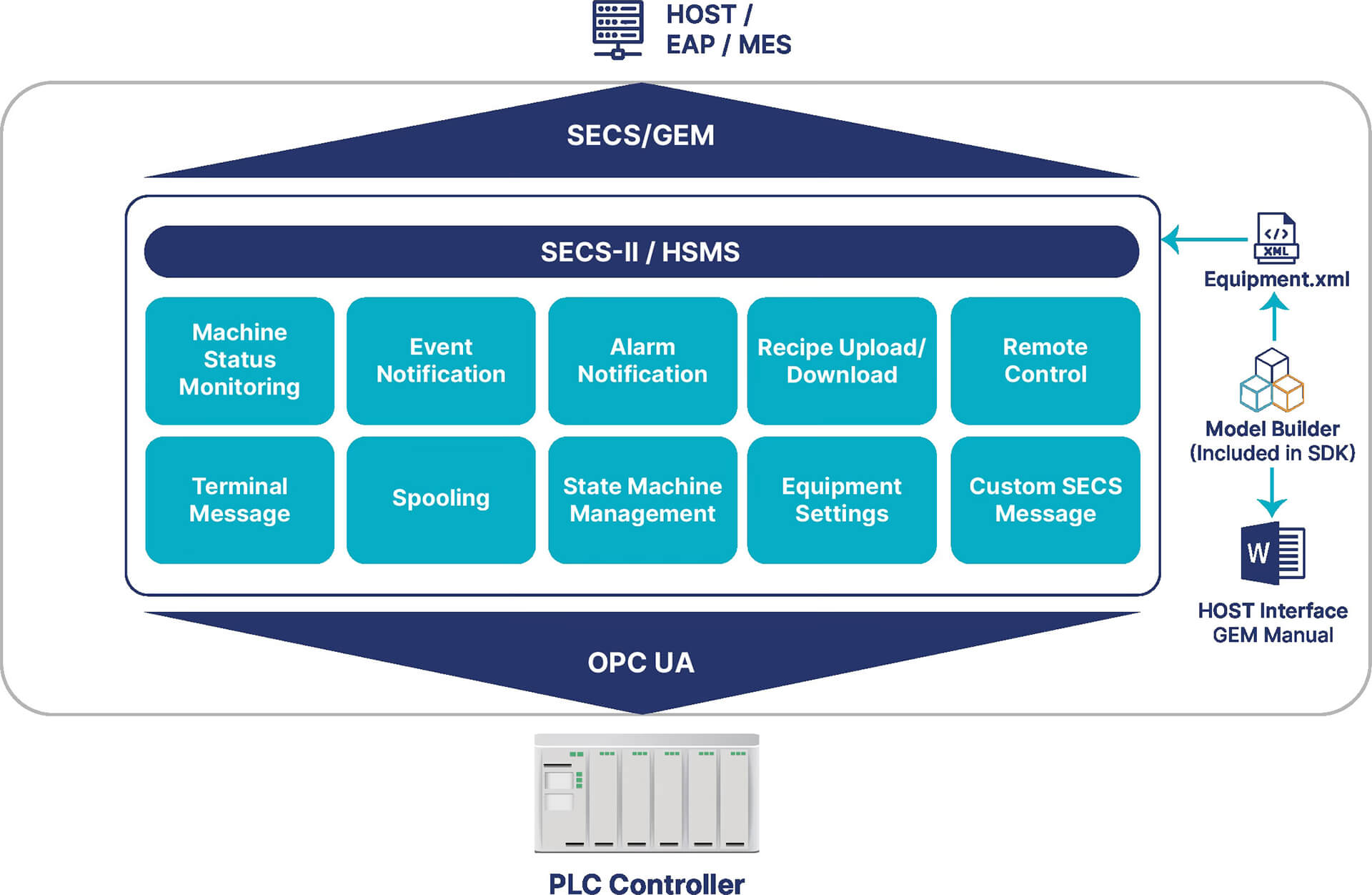
NxSphere® GEMBridge (formerly known as SecsToPLC.NET) is a no-code SECS/GEM gateway that connects PLC, Modbus, or SCADA-based machines (via OPC UA) to a factory host without changing any PLC program.
It lets you map equipment tags directly to GEM variables, events, alarms, and commands through a visual configuration interface, then deploys everything as managed Windows services for stable operation.
With built-in OPC tag import, intelligent tag-to-GEM mapping, custom handlers, and one-click SECS/GEM manual generation, GEMBridge gives engineering teams a fast, reliable way to achieve GEM compliance on PLC-controlled tools without custom development. It ensures clean host communication while letting your PLC logic stay exactly as it is.
Why OEMs Choose NxSphere® GEMBridge
- ✓No PLC Code Changes — achieve full SECS/GEM compliance without modifying existing PLC programs
- ✓Visual Tag-to-GEM Mapping — map OPC UA tags to GEM variables, events, alarms, and commands through a point-and-click interface
- ✓Auto SECS/GEM Reference Manual — one-click generation of your complete host integration documentation
Bridge PLC to Factory Host with Zero Code Changes
A complete OPC-to-SECS/GEM gateway with visual tag mapping, batch import, managed deployment, and automated documentation – everything you need to make PLC-controlled tools factory-ready.
Native OPC UA Connectivity
Connect directly to OPC UA, Modbus, and SCADA systems without custom drivers.
Visual Tag-to-GEM Mapping
Map status variables, CEIDs, alarms, and host commands visually - no coding required.
Rapid OPC Tag Import
Batch import OPC tags for fast configuration of GEM services.
Admin Panel
Deploy and monitor as managed Windows Services with a built-in admin dashboard.
Flexible Adaptation
Adapt easily to fab-specific requirements via extensible handlers and configuration.
Auto Documentation
One-click SECS/GEM manual generation for complete host integration specifications.
Learn More About NxSphere® GEMBridge
Windows 7/8/10+/Server; ≥2.4 GHz CPU; 2 GB RAM; 1GB disk; Ethernet
≥2.4 GHz CPU
2 GB RAM
1 GB disk
Ethernet
Your Trusted Worldwide Partner for SECS/GEM Integration
Related Products


Request a NxSphere® GEMBridge Demo
We Are Here To Help You
Speak to Our Experts
Our team will facilitate a NxSphere® GEMBridge demonstration targeted to your needs. Learn more about how our solution can work for you and your team!
Call Us
Why PLC-Based Equipment Needs SECS/GEM Integration
Why PLC-Based Equipment Needs SECS/GEM Integration
Modern semiconductor and electronics fabs need every tool on the floor to communicate through a standardized protocol, and for PLC-controlled equipment, that standard is SECS/GEM.
Factory Interoperability
PLC-based tools that lack native SECS/GEM support cannot participate in automated material handling, recipe management, or process control workflows, creating manual workarounds that slow down production.
SEMI Compliance Requirements
Fab customers increasingly mandate SEMI E30 (GEM) compliance as a condition of equipment qualification, meaning OEMs that cannot demonstrate compliant host communication risk losing orders at the procurement stage.
MES Communication
Manufacturing Execution Systems rely on standardized SECS/GEM event reporting and status variables to track equipment state, monitor yield, and trigger automated lot decisions, none of which are accessible from a PLC without a proper gateway layer.
Smart Factory Readiness
Industry 4.0 and smart factory initiatives require real-time equipment data to flow into host systems automatically.
Host Command Execution
Fabs expect to send remote commands such as recipe selects, start/stop signals, and parameter updates directly to equipment through the host. Without SECS/GEM, PLC tools have no standardized way to receive or acknowledge these instructions.
Challenges of Connecting PLC Equipment to Factory Hosts
Engineering teams can face the following challenges getting a PLC-controlled machine to communicate reliably with a factory host:
Protocol Incompatibility
PLCs natively speak Modbus, EtherNet/IP, or proprietary vendor protocols, none of which are understood by SECS/GEM factory hosts, requiring a translation layer that must be designed and validated from scratch.
Legacy PLC Communication Limitations
Older PLC platforms were designed for machine control with no built-in mechanism to produce event reports, expose status variables, or respond to GEM-defined commands in the format a fab host expects.
Costly Custom Development
Writing a custom SECS/GEM integration on top of an existing PLC program requires significant software engineering time, protocol expertise, and ongoing maintenance. These overheads that are difficult to justify for each new customer site or equipment variant.
Risk to Existing PLC Logic
Any modification to a validated PLC program triggers re-qualification cycles. OEMs that embed host integration code directly into PLC logic must either accept that risk or maintain separate, divergent codebases for each deployment.
Host Interoperability Issues
Even when a basic connection is established, different fab customers often have specific GEM capability requirements, custom event definitions, or bespoke command sets that a generic integration cannot accommodate without rework.
Benefits of Using a SECS/GEM PLC Gateway
A dedicated SECS/GEM gateway eliminates the need to rebuild PLC integration from the ground up, giving OEM engineering teams a faster, lower-risk path to host compliance on every tool they ship.
Faster Fab Qualification
Pre-built SECS/GEM logic and visual configuration dramatically reduce the time required to bring a PLC-controlled tool to host compliance, shortening integration timelines from months to days.
Reduced Engineering Effort
Achieving SECS/GEM compliance on a PLC machine without a gateway requires custom software development. A no-code gateway removes that burden entirely.
No-Code Deployment
Engineering teams can configure GEM variables, events, alarms, and commands through a point-and-click interface with no scripting or driver development required at any stage.
Preservation of Existing PLC Logic
Because the gateway connects via OPC UA rather than modifying the PLC program, validated machine control logic remains untouched and re-qualification risk is eliminated.
Simplified Host Communication
The gateway handles all SECS/GEM message formatting, session management, and protocol compliance, so the PLC only needs to expose its data through standard tags.
Improved Smart Factory Compatibility
Once PLC equipment is GEM-compliant, it can participate fully in automated dispatching, recipe management, and real-time monitoring alongside natively compliant tools in the same fab.
Common Use Cases for SECS/GEM Gateway Integration
NxSphere® GEMBridge addresses a wide range of integration scenarios where standard SECS/GEM driver approaches are either impractical or insufficient for the underlying equipment architecture.
Upgrading Legacy PLC-Controlled Equipment
Older tools running on PLC platforms can be brought into full GEM compliance without replacing hardware or rewriting machine control programs.
Enabling SECS/GEM Compliance on Hybrid Machines
Equipment that combines PLC-based motion or process control with SCADA-level supervision can be unified under a single SECS/GEM interface through OPC UA connectivity.
Connecting SCADA Systems to Factory Hosts
SCADA platforms managing multi-axis or process-intensive equipment can expose their tag data to a fab host as structured GEM services without any modification to the SCADA application.
Integrating OPC UA-Driven Manufacturing Tools
Machines that already publish data over OPC UA can be connected directly to a SECS/GEM factory host using GEMBridge's native OPC UA interface and batch tag import capability.
Accelerating OEM Equipment Qualification
Equipment builders delivering tools to new fab customers can use the GEMBridge OEM SECS/GEM solution to meet site-specific requirements quickly, without maintaining a separate integration build for each customer.
Bridging Modbus Devices to Semiconductor Fabs
Instruments and subsystems that communicate over Modbus can be brought into GEM compliance through GEMBridge's Modbus support, extending factory host visibility to equipment that was previously unreachable.
Supporting Smart Factory & Industry 4.0 Integration
Supporting Smart Factory & Industry 4.0 Integration
PLC-controlled equipment does not have to be a barrier to smart factory adoption. With the right gateway layer, it can become a fully connected node in a modern, data-driven production environment.
MES Integration
GEMBridge exposes PLC equipment state, process data, and event history through standardised GEM services, giving MES platforms the structured data feed they need for lot tracking, scheduling, and yield analysis.
Real-Time Equipment Monitoring
Live status variables and event-driven reports flow continuously from PLC tools to the factory host, enabling operations teams to monitor equipment health and production status without manual data collection.
Automated Recipe and Parameter Management
Host systems can push recipe selects and process parameters directly to PLC-controlled tools via GEM remote commands, enabling centralised process control across the entire tool set.
Factory Automation Readiness
GEMBridge-enabled tools respond to host-initiated commands and report process events in real time, allowing them to participate in automated material handling, interlock workflows, and production scheduling.
Modernization Without Replacement
Legacy PLC tools that cannot be replaced can still be brought into Industry 4.0 environments by adding a compliant SECS/GEM interface at the gateway level rather than through hardware upgrades.
Scalable Multi-Tool Deployment
GEMBridge deploys as managed Windows Services and can be replicated across multiple tools and equipment variants, supporting large-scale smart factory rollouts without per-tool custom engineering.
Industries We Support
GEMBridge is built for any production environment where PLC-controlled or OPC UA-enabled equipment needs to communicate with a factory host through a standardised SECS/GEM interface.
Semiconductor Manufacturing
Wafer processing, etch, deposition, and metrology tools built on PLC or SCADA architectures can achieve full GEM compliance and qualify for host integration in leading-edge fabs.
Electronics Manufacturing
PCB assembly, test, and inspection equipment that uses PLC-based machine control can be connected to factory automation systems without changes to existing machine logic or hardware.
Photovoltaic and Solar Manufacturing
Solar cell and module production lines running on PLC controllers can be brought into standardised host communication to support yield tracking, process optimization, and MES integration.
SMT Production
Surface mount technology lines where placement, soldering, and inspection equipment operate on distributed PLC architectures benefit from a unified SECS/GEM interface that consolidates host communication across the entire line.
Industrial Automation
General manufacturing environments adopting semiconductor-style automation standards can use GEMBridge to bridge existing PLC infrastructure into a compliant, host-connected factory network.
Hybrid Equipment Environments
Production facilities running a mix of native SECS/GEM tools and PLC-controlled machines can standardise host communication across the entire floor using GEMBridge alongside existing GEM drivers.
Frequently Asked Questions
What is NxSphere® GEMBridge and who is it for?
NxSphere® GEMBridge is a no-code SECS/GEM gateway designed for equipment that uses PLCs, Modbus, or SCADA controllers. It enables OEMs and integrators to achieve SECS/GEM host compliance on PLC-controlled tools without writing SECS/GEM driver code or modifying existing PLC programs.
Do I need to change my PLC code to use GEMBridge?
No. GEMBridge connects to your equipment via OPC UA and maps PLC tags to GEM services through a visual configuration interface. Your existing PLC logic stays exactly as it is.
What protocols does NxSphere® GEMBridge support?
GEMBridge connects to equipment via OPC UA, Modbus, and SCADA protocols. On the host side, it communicates using standard SECS/GEM over HSMS (TCP/IP).
How is GEMBridge deployed on the equipment?
GEMBridge deploys as managed Windows Services. The built-in Admin Panel lets you configure, deploy, and monitor all GEMBridge instances from a single dashboard.
Can GEMBridge handle custom fab-specific requirements?
Yes. GEMBridge supports extensible custom handlers that let you implement bespoke messaging workflows beyond standard GEM services, adapting to specific factory host requirements.
Is a free evaluation of NxSphere® GEMBridge available?
Yes. NxSphere® GEMBridge offers a free 30-day evaluation with full functionality, so you can test the complete gateway in your own environment before committing.
What is a SECS/GEM PLC gateway?
A SECS/GEM PLC gateway is a middleware layer that translates PLC tag data into standardised SECS/GEM messages, allowing PLC-controlled equipment to communicate with a semiconductor factory host without requiring changes to the underlying machine control program.
How does OPC UA integrate with SECS/GEM?
OPC UA acts as the data transport layer between the PLC and the gateway, exposing machine tags as structured objects that GEMBridge maps to GEM variables, events, alarms, and commands for transmission to the factory host over HSMS.
Can legacy PLC equipment become SECS/GEM compliant?
Yes, GEMBridge supports SECS/GEM for legacy equipment. As long as the PLC supports OPC UA or Modbus communication, GEMBridge can read its tag data and present it to a factory host as fully compliant SECS/GEM services, with no modifications to the existing PLC program required.
What are the benefits of no-code SECS/GEM integration?
No-code integration eliminates the need for custom driver development and deep protocol expertise, allowing engineering teams to configure, deploy, and maintain full GEM compliance through a visual interface rather than writing and debugging custom integration code.