
A Complete SECS/GEM Toolkit, Out of the Box
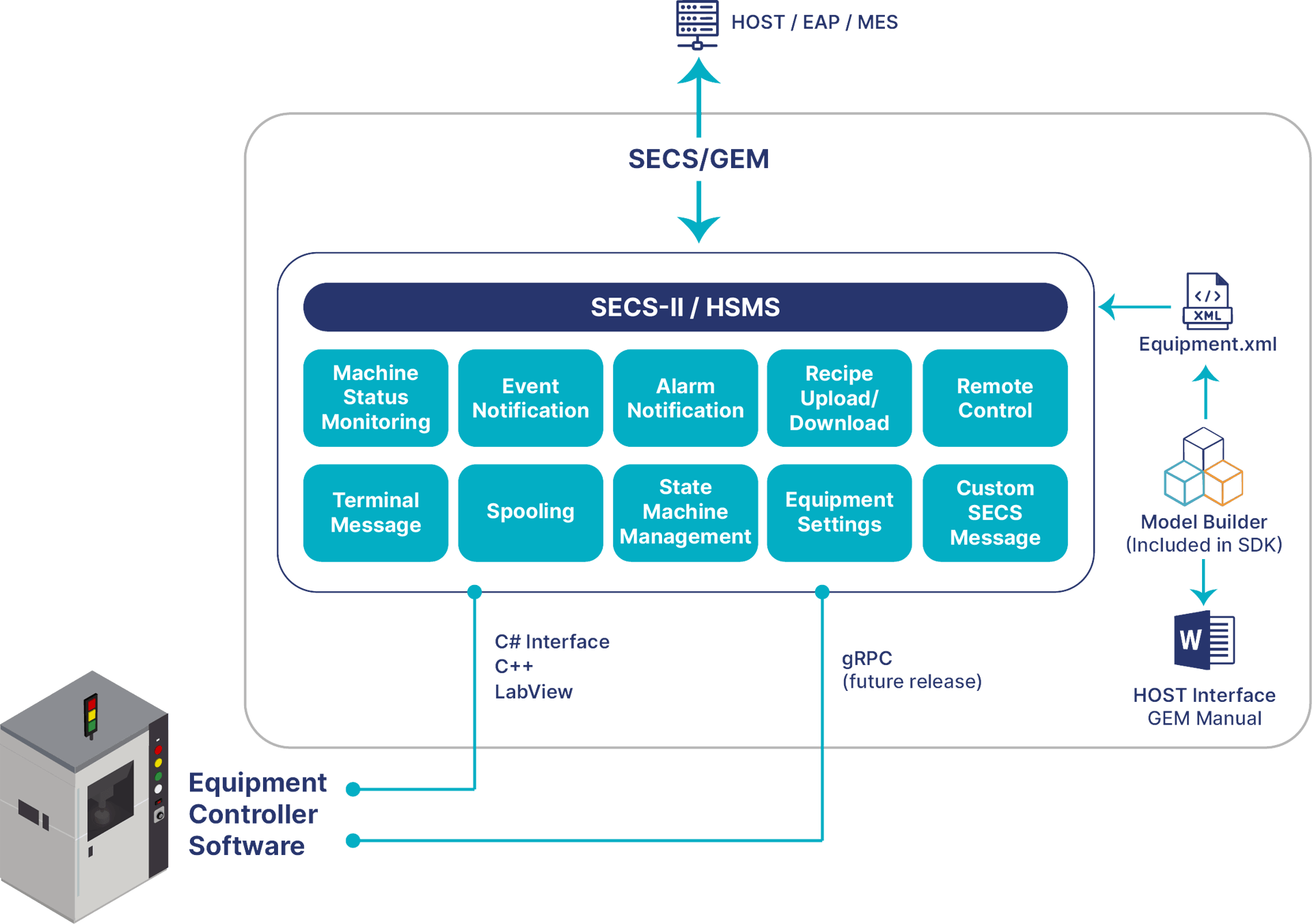
NxSphere® GEM (formerly known as SecsToHost.NET) is a fast, reliable SECS/GEM SDK for equipment makers who need full SEMI compliance with minimal development effort. It provides a complete SECS/GEM communication library with .NET support, intelligent APIs, and built-in protocol handling.
It includes a visual Model Builder for easy configuration of all GEM services and data items, a built-in SECS/GEM simulator for offline testing, and supports the full SECS/GEM communication protocol including HSMS (TCP/IP).
With ready-to-use samples, automated GEM30 manual generation, and an easy upgrade path to NxSphere® GEM300, your team ships GEM-compliant equipment faster. NxSphere® GEM is trusted SECS/GEM software used by OEMs worldwide.
Why OEMs Choose NxSphere® GEM
- ✓Full GEM Out of the Box — events, alarms, recipes, remote commands, spooling, state models, and Stream 21 Large Recipe
- ✓Ship Faster — prebuilt samples, host simulator, and ready-to-use templates accelerate your development
- ✓Auto GEM Reference Manual — one-click generation of your complete SECS/GEM documentation in Word format
Everything You Need for SECS/GEM Compliance
A complete SECS/GEM SDK with intelligent APIs, visual configuration, built-in simulator, and automated documentation — everything OEMs need to deliver compliant equipment.
Intelligent API
Async/await and event-driven callbacks for simplified SECS/GEM integration.
Full GEM Functionality
Events, alarms, recipes, remote commands, data collection, spooling, state models, and Stream 21 Large Recipe support.
Visual Configuration
Model Builder for easy point-and-click configuration of all GEM services and data items.
Automated Documentation
One-click auto-generation of your complete SECS/GEM manual in Microsoft Word format.
Accelerate Time-to-Market
Streamline deployment with prebuilt samples and a ready-to-use host simulator.
Integrated Troubleshooting
SML logging and built-in LogViewer for easy debugging and issue resolution.
Learn More About NxSphere® GEM
Supported SEMI Standards
Documentation and Support
NxSphere® GEM includes a Quick Start Guide to help you connect and run your first SECS/GEM session in minutes, plus a comprehensive Developer Guide designed for users with little or no SECS/GEM domain knowledge. With auto-generated Host Communication Spec manuals from Model Builder and ready-to-use sample applications, developers can learn by doing while staying fully aligned with SEMI standards. Combined with responsive support for setup, troubleshooting, and customization, NxSphere® GEM ensures you can go from zero to GEM-ready quickly and confidently.
Programming Interface
C#, VB.NET, Python, Visual C++, LabVIEW gRPC (coming soon)
Multiplatform Support
Microsoft Windows 32-bit and 64-bit
Linux 32-bit and 64-bit
System Requirements
Windows Server 2019/2016/2012 R2; Windows 7/8/10/11; ≥1.3 GHz CPU; 1 GB RAM; 200 MB disk; Ethernet
Your Trusted Worldwide Partner for SECS/GEM Integration
Related Products

Request a NxSphere® GEM Demo
We Are Here To Help You
Speak to Our Experts
Our team will facilitate a NxSphere® GEM demonstration targeted to your needs. Learn more about how our solution can work for you and your team!
Call Us
What Is SECS/GEM & Why It Matters for Semiconductor Equipment
What Is SECS/GEM & Why It Matters for Semiconductor Equipment
SECS/GEM is the semiconductor industry’s standard protocol for equipment-to-host communication, and any OEM selling into a modern fab needs to support it.
Equipment Communication Standards
SECS/GEM defines how equipment exchanges messages with a factory host, covering everything from connection management and event reporting to alarm notification and remote command execution, all governed by SEMI standards E4, E5, E30, and E37.
Semiconductor Factory Interoperability
Fabs run tools from dozens of different OEMs; SECS/GEM provides the common language that allows all of them to connect to a single factory automation system without bespoke point-to-point integrations.
MES Communication
Manufacturing Execution Systems depend on structured GEM data such as process events, equipment states, and data variable reports to make automated lot disposition decisions, track yield, and enforce process control limits in real time.
Equipment Qualification Requirements
Most semiconductor fabs will not qualify a tool for production use unless it demonstrates full GEM compliance; for OEMs, SECS/GEM support is a commercial prerequisite, not an optional feature.
Smart Manufacturing Requirements
Advanced fabs pursuing predictive maintenance, automated process control, and real-time analytics require continuous, standardised data streams from every tool, all of which flow through the SECS/GEM communication layer.
Challenges of Developing SECS/GEM Communication Software In-House
Building a reliable SECS/GEM implementation from scratch is a significant engineering undertaking that pulls resources away from the core equipment development your team was hired to do.
Complex Protocol Implementation
SECS/GEM spans multiple interdependent SEMI standards, each with precise message structures, state machine requirements, and sequencing rules that must be implemented correctly before a single GEM service can function.
Maintaining SEMI Compliance
SEMI standards evolve, and keeping an in-house implementation aligned with current E30, E37, and related specifications requires ongoing engineering attention that compounds over the lifetime of the product.
Debugging Communication Workflows
Diagnosing failures in SECS/GEM sessions is time-consuming without dedicated tooling; engineers working from raw SML logs must trace message sequences manually across complex state transitions to identify the root cause of host communication issues.
Integrating with Diverse Factory Hosts
Different fabs run different host systems with varying GEM capability expectations, and an in-house implementation built against one host configuration frequently requires rework when deployed at a new customer site.
Long Development Timelines
A complete, production-grade SECS/GEM implementation covering all required GEM services, spooling, state models, and documentation can take months to develop and validate, delaying equipment shipment and pushing back customer qualification schedules.
Knowledge Concentration Risk
In-house SECS/GEM codebases are typically maintained by a small number of engineers with deep protocol expertise; when those individuals leave or move to other projects, the knowledge gap becomes a serious long-term support liability.
Benefits of Using a SECS/GEM SDK for OEM Equipment
A purpose-built SECS/GEM SDK removes the heaviest engineering burden from equipment development, letting your team focus on the machine rather than the protocol.
Faster Time to Market
Prebuilt SECS GEM solutions, ready-to-use sample programs, and a built-in host simulator mean your team can build, test, and validate SECS/GEM communication in a fraction of the time compared to implementation from scratch.
Simplified SEMI Compliance
NxSphere® GEM implements the full SEMI E30, E37, E4, and E5 standard requirements out of the box, so engineering teams achieve compliant host communication without needing to interpret or manually implement each specification.
Reduced Engineering Overhead
Intelligent APIs, visual Model Builder configuration, and automated GEM30 manual generation eliminate repetitive low-value tasks, freeing senior engineers to focus on equipment functionality rather than protocol scaffolding.
Reliable Host Communication
A proven, production-tested SDK reduces the risk of communication failures, session handling errors, and state machine defects that commonly surface in custom-built SECS/GEM implementations during factory qualification.
Scalable Factory Automation Support
NxSphere® GEM supports the full range of GEM services required by modern fabs, including spooling, remote commands, and Stream 21 Large Recipe, and offers a direct upgrade path to NxSphere® GEM300 for 300 mm requirements.
Reduced Documentation Effort
One-click generation of a complete, SEMI-compliant Host Communication Specification manual saves weeks of manual documentation work and ensures your integration documentation stays accurate as the implementation evolves.
Common Use Cases for SECS/GEM Driver Software
NxSphere® GEM is deployed across a wide range of equipment types and integration scenarios where reliable, standards-compliant host communication is a hard requirement.
New OEM Equipment Development
Equipment makers building tools for semiconductor or electronics fabs integrate NxSphere® GEM from the ground up to deliver fully GEM-compliant host communication without writing protocol-level code.
Host Communication Enablement
OEMs shipping equipment to fab customers that mandate SECS/GEM compliance use NxSphere® GEM to meet qualification requirements quickly and consistently across multiple customer sites.
Legacy Tool Upgrades
Older equipment that was built without SECS/GEM support can be upgraded by integrating NxSphere® GEM into the equipment software stack, restoring host connectivity without requiring hardware replacement.
Automated Production Systems
Equipment operating in lights-out or highly automated fab environments relies on NxSphere® GEM to receive host commands, report process events, and maintain continuous session availability without manual intervention.
Smart Factory Deployments
OEMs delivering tools into Industry 4.0 environments use NxSphere® GEM to ensure their equipment can participate in real-time data collection, automated dispatching, and centralised process control from day one of installation.
300 mm Equipment Integration
Development teams building tools for 300 mm fabs start with NxSphere® GEM for standard GEM compliance and migrate to NxSphere® GEM300 when E40, E87, E90, and other GEM300 capabilities are required at the customer site.
Supporting Smart Factory & Industry 4.0 Connectivity
Supporting Smart Factory & Industry 4.0 Connectivity
SECS/GEM is the foundational communication layer that makes equipment visible, controllable, and data-ready for smart factory automation.
MES Integration
NxSphere® GEM exposes structured equipment data including process events, status variables, and alarm states through standardised GEM services, giving MES platforms the reliable data feed they need for lot tracking, yield management, and automated process control.
Real-Time Equipment Communication
Event-driven reporting and continuous status variable updates allow factory hosts to monitor equipment state and process conditions in real time, supporting rapid response to process deviations and unplanned downtime.
Predictive Maintenance Enablement
Continuous GEM data collection from equipment sensors and process variables gives maintenance systems the historical and live data they need to identify degradation trends before failures occur.
Automated Production Workflows
Host-initiated remote commands delivered through GEM allow factory automation systems to trigger recipe selects, process starts, and parameter updates directly on equipment, removing manual operator steps from standard production workflows.
Centralised Process Control
GEM-compliant equipment can participate in fab-wide process control initiatives where host systems push parameter changes, collect data collection reports, and enforce process limits across entire tool sets from a single control platform.
Smart Manufacturing Readiness
Equipment built on NxSphere® GEM is ready to connect to any SEMI-compliant factory automation infrastructure, supporting current smart factory deployments and the more demanding data and control requirements of next-generation fabs.
Industries We Support
NxSphere® GEM is used by OEMs and system integrators across every industry sector where semiconductor-grade equipment communication standards are required.
Semiconductor Manufacturing
Wafer processing, lithography, etch, deposition, inspection, and metrology equipment builders rely on NxSphere® GEM to deliver GEM-compliant host communication that meets the qualification standards of leading-edge fabs worldwide.
Electronics Manufacturing
PCB fabrication, functional test, and automated inspection equipment makers use NxSphere® GEM to connect their tools to factory automation systems and meet the host communication requirements of advanced electronics production facilities.
Photovoltaic and Solar Manufacturing
Solar cell and module equipment OEMs use NxSphere® GEM with PV2 (PVECI) support to achieve standardised host communication in photovoltaic production lines, enabling MES integration and automated process control.
SMT Production
Surface mount technology equipment including placement, reflow, and automated optical inspection systems integrates NxSphere® GEM to connect to factory host systems and participate in line-level production tracking and control.
Optoelectronics
Equipment used in LED, laser, and optoelectronic device manufacturing integrates NxSphere® GEM to meet the host communication and data collection requirements of precision fabrication environments operating to semiconductor-grade standards.
Industrial Automation
Manufacturing operations outside traditional semiconductor fabs that have adopted SEMI-based automation standards use NxSphere® GEM to bring their equipment into compliant, host-connected production networks.

Frequently Asked Questions
What is SECS/GEM and what does it stand for?
SECS/GEM (SEMI Equipment Communications Standard / Generic Equipment Model) defined by SEMI is the industry standard protocol for communication between semiconductor manufacturing equipment and factory host systems. It defines how machines report status, events, alarms, and process data to the factory MES. NxSphere® GEM implements the full SECS/GEM standard.
What is NxSphere® GEM and who is it for?
NxSphere® GEM is a SECS/GEM SDK and communication library designed for equipment OEMs who need to build SEMI-compliant tools. It provides .NET libraries, intelligent APIs, a visual Model Builder, and a built-in Host simulator.
What SECS/GEM communication protocol does NxSphere® GEM support?
NxSphere® GEM supports the full SECS/GEM communication protocol including SECS-II message encoding, GEM state models, HSMS (TCP/IP) and SECS-I (RS232) transport. It covers SEMI E4, E5, E30, E37, E39, and E40 standards.
Does NxSphere® GEM include a SECS/GEM simulator?
Yes. NxSphere® GEM includes a built-in SWIFT Simulator that emulates the host endpoint, allowing you to validate SECS/GEM communication instantly without needing a live factory connection.
How do I get started with SECS/GEM development?
NxSphere® GEM includes comprehensive sample programs, a Quick Start Guide, and a SECS/GEM simulator for hands-on learning. The visual Model Builder lets you configure GEM services without writing SECS/GEM protocol code. A free 30-day evaluation is available.
How do I upgrade from NxSphere® GEM to NxSphere® GEM300?
A .NET SECS/GEM SDK gives equipment developers a ready-to-use communication library with intelligent APIs, prebuilt GEM services, and sample programs, eliminating the need to implement the protocol from scratch and significantly reducing development time and compliance risk.
What are the benefits of using a .NET SECS/GEM SDK?
A SECS/GEM PLC gateway is a middleware layer that translates PLC tag data into standardised SECS/GEM messages, allowing PLC-controlled equipment to communicate with a semiconductor factory host without requiring changes to the underlying machine control program.
Can SECS/GEM software integrate with MES systems?
Yes. SECS/GEM is the standard communication layer between equipment and factory host systems, and NxSphere® GEM exposes the structured event reports, status variables, and alarm data that MES platforms require for lot tracking, yield management, and automated process control.
How does SECS/GEM improve semiconductor factory automation?
SECS/GEM factory integration software enables factory hosts to monitor equipment state, collect process data, send remote commands, and trigger automated workflows in real time, forming the communication backbone of any semiconductor factory automation system.
What industries use SECS/GEM communication software?
SECS/GEM for equipment manufacturers is used primarily in semiconductor manufacturing, but is also widely adopted in electronics, photovoltaic and solar, SMT, optoelectronics, and other precision manufacturing industries that require standardised equipment-to-host communication.