NxSphere® GEM300
Simplify GEM300 Development
for Your Equipment
NxSphere® GEM300 adds carrier management, substrate tracking and job control to your equipment software, with built-in state machines, visual modeling and offline testing.
Multiple Standards. Interdependent Workflows. Where Do You Start?
Automated 300 mm fabs need equipment to coordinate carrier handling, substrate tracking and processing jobs. SEMI GEM300 standards define these automation capabilities—but turning the requirements into working equipment software introduces several challenges.
Complex Standards to Implement
Multiple specifications, object models and required events make it difficult to translate customer requirements into working software.
Interdependent State Machines
Carriers, substrates and jobs must stay coordinated throughout the workflow. Implementing each standard separately is only part of the work.
Complete Workflows to Verify
Successful message exchanges do not prove the entire workflow behaves correctly. Issues found during customer integration can lead to rework and delays.
One SDK for Your GEM300 Implementation
NxSphere® GEM300 builds on NxSphere® GEM to bring carrier management, substrate tracking and job control into your equipment software. Configure your equipment model and connect your control logic through the SDK API, while it handles supported communication and state-model behavior. Your application stays in control of the machine.
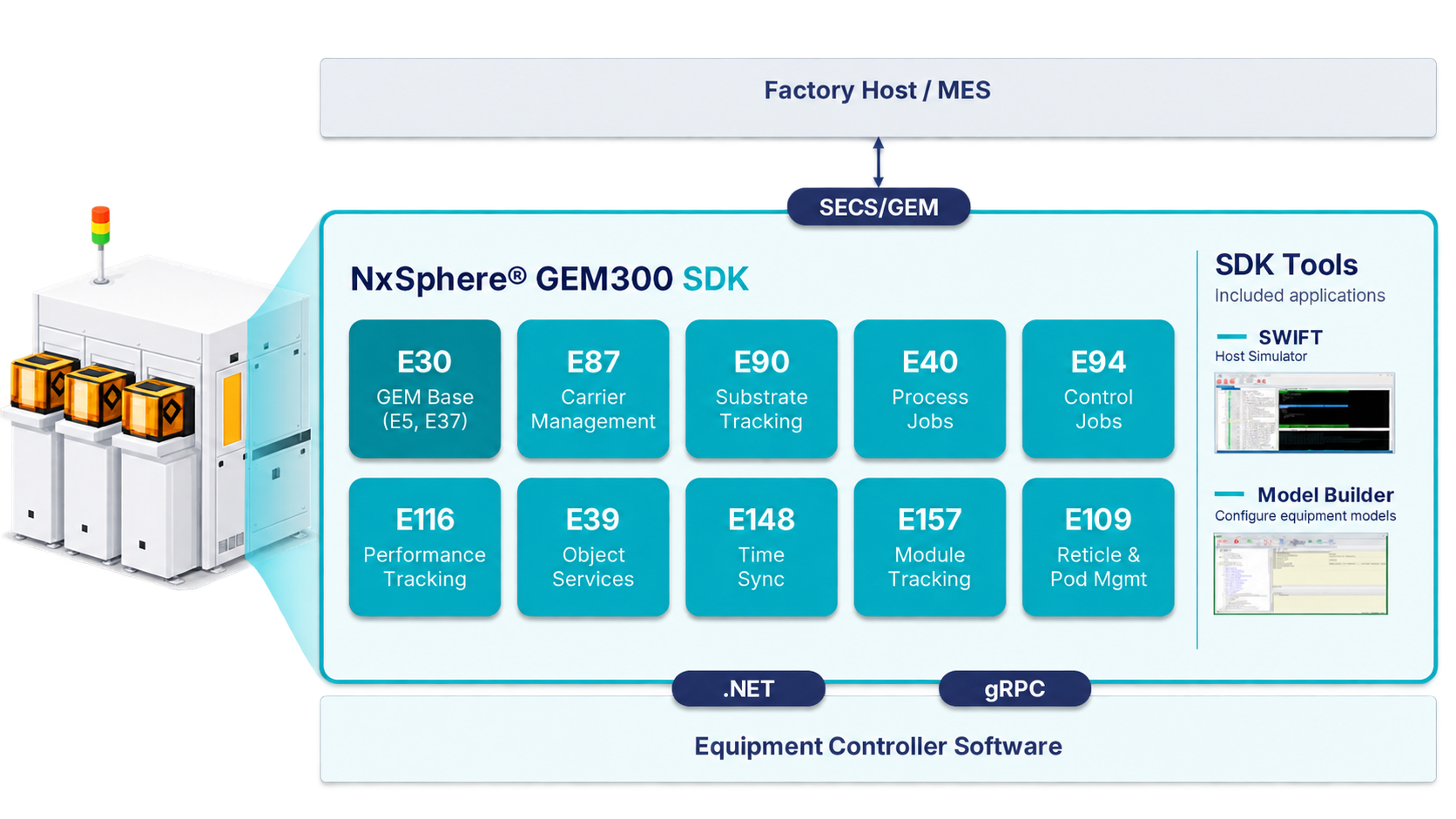
- Native .NET integration: Embed the GEM300 library directly into your C# or VB.NET application using the .NET DLL.
- gRPC integration: Connect applications written in any programming language with gRPC support, running on Windows or Linux.
- Modular: add only the standards you use. A reticle tool can run E109 without E87
- Works with your existing architecture, on Windows or Linux (32-bit and 64-bit)
- Upgrade from NxSphere® GEM seamlessly.
Start with Your Equipment Model
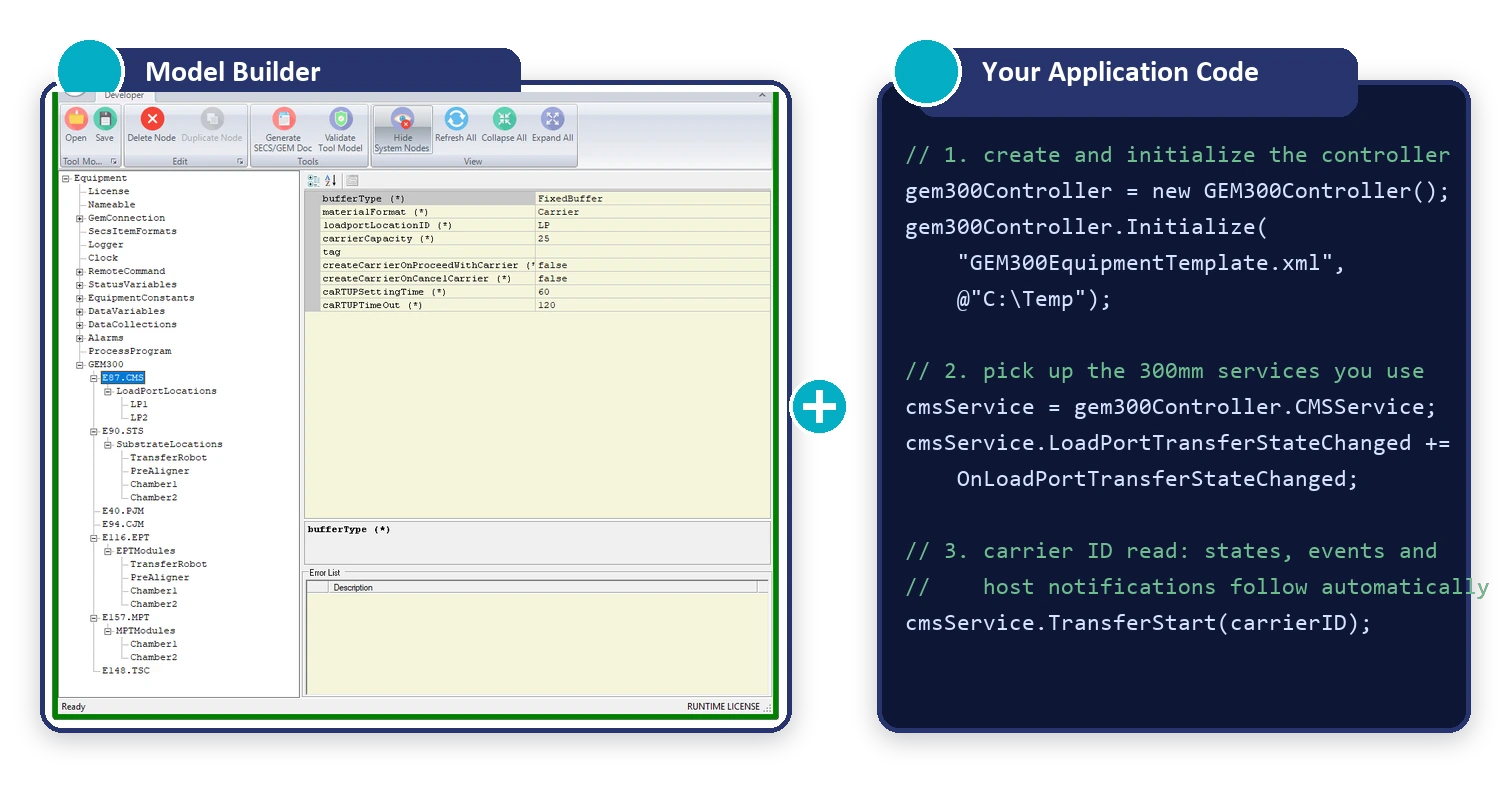
Use Model Builder to define load ports, substrate locations, process modules and jobs. Build your GEM300 implementation around the equipment you know, with the associated variables, events and alarms created from your configured services.
- Model Builder creates the SVIDs, DVIDs, ECIDs, CEIDs and alarms each GEM300 service needs
- Fixed Buffer or Internal Buffer equipment, with state saved across restarts
Let the Intelligent API Manage Your GEM300 State Machines
Carrier, substrate and job services need to respond consistently as equipment activity progresses. The Intelligent API manages supported state machines and their dependencies, reducing coordination code in your application.
- Built-in handling for supported E87, E90, E40, E94 and E116 state models
- Report equipment activity through the API
- Keep hardware actions, process logic and recovery decisions in your application
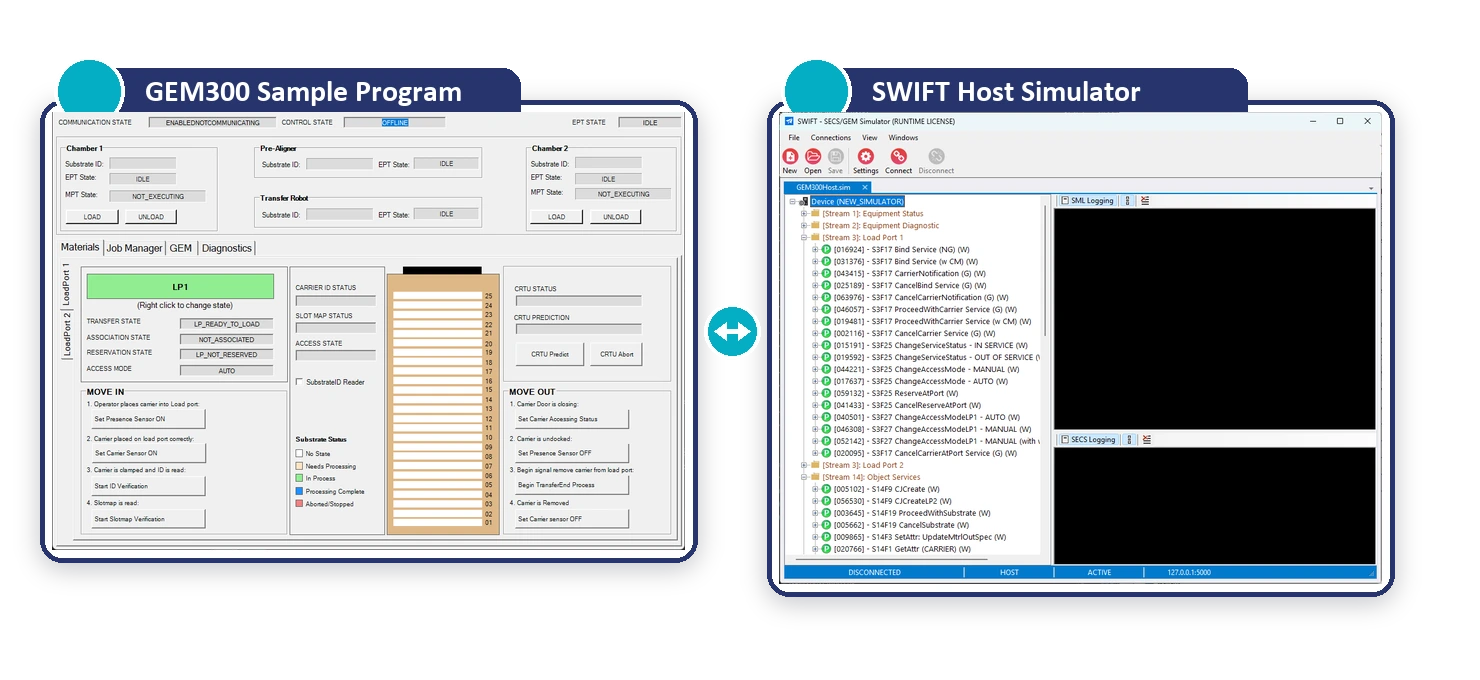
A quick start for complete GEM300 workflows. Use the included sample program to see the Intelligent API in action and run a full round trip—from carrier arrival and verification to job creation, processing and carrier out.
Test Complete Workflows Before Factory Integration
SWIFT Host Simulator comes with preconfigured GEM300 host messages to test complete equipment workflows in-house. Run host interactions against the sample program or your equipment application, verify responses and identify issues before connecting to your customer’s factory host.
- Carrier arrival, ID and slot map verification, job creation, processing and carrier out
- Pre-built host messages for Bind, ProceedWithCarrier, PRJobMultiCreate and CJ Create
- Fixed Buffer, Internal Buffer and reticle transfer scenarios, aligned with SELETE and SEMATECH
Generate Your GEM300 Interface Manual from Your Model
Manually maintaining interface documentation takes time and creates opportunities for inconsistencies. Generate the GEM300 interface manual from your configured equipment model and regenerate it as your implementation changes.
- SECS-II messages, variables, collection events and alarms for your tool
- SEMI compliance statements for E87, E90, E40, E94, E116, E148 and E157
- Export to Word and regenerate after any model change
- Save weeks of manual documentation work
Restore Saved State After Software Restarts
Save and restore supported carrier, substrate, job and GEM data across equipment software restarts, reducing custom persistence code. Your equipment application reconciles restored software state with physical conditions and controls safe recovery.
- Auto-save with a configurable delay, plus a save at graceful shutdown
- Switch persistence on or off per standard: E87, E90, E40, E94 and GEM data
- Variables, reports, event links and alarm enables restored too
- No manual state tracking in your equipment code
Start Building with NxSphere® GEM300
Learn More About NxSphere® GEM300
The SEMI GEM300 standards are powerful but highly complex, requiring careful coordination of carriers, substrates, jobs and reticles. NxSphere® GEM300 is designed to simplify this journey with clear, developer-focused resources.
A Quick Start Guide walks you through the essentials, and a step-by-step workflow guide runs the full round-trip GEM300 scenario exactly as defined by SELETE and SEMATECH. A comprehensive Developer Guide covers every detail from material move-in to job control and exception handling, supported by working sample applications for carriers and reticles, and by a GEM300 interface manual that Model Builder generates for you.
Programming Interface
C#, VB.NET, Python, gRPC
Multiplatform Support
Microsoft Windows 32-bit and 64-bit
Linux 32-bit and 64-bit
System Requirements
Windows Server 2019/2016/2012 R2, Windows 7/8/10/11, ≥1.3 GHz CPU, 1 GB RAM, 200 MB disk, Ethernet
Trusted by Wafer Tool Makers
Customer feedback on NxSphere® GEM300
We’ve been using NxSphere® GEM300 for over a decade to integrate SECS/GEM functionality into our metrology equipment.
Its modular architecture, broad feature set, and short learning curve have proven to be invaluable assets to our development process. Day after day, NxSphere® GEM300 continues to convince us with its stability and performance.
On top of that, Insphere’s support is fast, competent, and always willing to go the extra mile.
Software Development Manager
Metrology equipment manufacturer
Customer references available upon request.
Company identities are withheld for confidentiality. Reference introductions are subject to customer consent.
Contact Us
WE ARE HERE TO HELP YOU
Speak to Our SECS/GEM Experts
Request a trial or book a demo of NxSphere® GEM300 tailored to your equipment. Tell us about your project and our team will be in touch.
Call Us
Related Products
Explore other ways to connect and automate your equipment.
NxSphere® GEM
For equipment needing SECS/GEM communication
Add SECS/GEM communication to your equipment software with a proven SDK.
Explore GEM →NxSphere® GEMBridge
For PLC-controlled equipment
Connect equipment to a SECS/GEM factory host through an OPC UA gateway.
Explore GEMBridge →GEM300 Explained: What It Covers and Why Fabs Require It
GEM300 Explained: What It Covers and Why Fabs Require It
GEM300 is a suite of SEMI standards that defines how 300mm semiconductor equipment communicates with factory automation systems. It addresses the additional complexity of automated 300mm fabs, where carriers, substrates, and process jobs must be coordinated precisely across equipment, hosts, and material handling systems.
Here’s what GEM300 covers and why it matters for modern semiconductor manufacturing.
Carrier management (SEMI E87)
Defines how equipment manages carrier states, load port access modes, and material handoffs with automated transport systems.
Substrate tracking (SEMI E90)
Provides wafer-level visibility across the production floor, tracking substrate location and status throughout the process flow.
Control job management (SEMI E94)
Coordinates multi-step processing jobs across equipment, linking lot control to process job execution.
Processing job management (SEMI E40)
Manages the creation, execution, and completion of individual process jobs at the equipment level.
Equipment performance tracking (SEMI E116)
Standardizes how equipment reports utilization, availability, and performance metrics to factory host systems.
Reticle and pod management (SEMI E109)
Defines how equipment manages reticle pods and the reticles inside them: where each pod and reticle is, whether what arrived matches what the host announced, and which reticles are qualified for use. It applies to lithography tools, reticle inspection tools and reticle stockers.
Time and module tracking (SEMI E148, E157)
SEMI E148 synchronizes the equipment clock with the factory host over NTP. SEMI E157 tracks process execution at each process module, from recipe start through the steps to completion.
Fab interoperability
300mm fabs require GEM300 compliance for tool qualification. Without it, equipment cannot be accepted into automated production environments.
Industry 4.0 readiness
As fabs push toward full automation, GEM300 compliance is the prerequisite for connecting tools to MES, AMHS, and smart factory platforms.
Key SEMI Standards Supported by NxSphere® GEM300
NxSphere® GEM300 provides complete coverage of the SEMI standards required for 300mm equipment compliance. Each standard is fully implemented and integrated, with automatic handling of the state models and interdependencies that connect them.
SEMI E5 (SECS-II)
Defines the message content and data structure for SECS communications between equipment and hosts.
SEMI E37 (HSMS)
High-Speed Message Services protocol for TCP/IP-based SECS-II communication.
SEMI E39 (OSS)
Object Services Standard, defining how equipment objects are identified and referenced by host systems.
SEMI E40 (PJM)
Processing Job Management, governing the execution and lifecycle of individual process jobs at the equipment level.
SEMI E87 (CMS)
Carrier Management Standard, defining load port states, carrier IDs, and material handoffs with automated transport systems.
SEMI E90 (STS)
Substrate Tracking Standard, providing wafer-level tracking across the production floor from entry to completion.
SEMI E94 (CJM)
Control Job Management, coordinating multi-step lot processing across equipment and process jobs.
SEMI E116 (EPT)
Equipment Performance Tracking, standardizing how equipment reports utilization, availability, and performance data.
SEMI E148 (TSC)
Time Synchronization Clock, synchronizing the equipment clock with the factory host over NTP and reporting the synchronization status as object attributes.
SEMI E157 (MPT)
Module Process Tracking, reporting the execution state of each process module from recipe start through the steps to completion.
SEMI E109 (RPMS)
Reticle and Pod Management, tracking reticle pods and reticles at load ports, in internal buffers and on library shelves, with verification and qualification before use.
What OEM Teams Gain from a GEM300 SDK
Choosing purpose-built GEM300 software changes the development calculus for OEM engineering teams. Rather than building compliance from the ground up, teams deploy a validated foundation and direct their effort toward the tool capabilities that differentiate their products.
Faster fab acceptance
Pre-validated, SEMI-compliant SDKs eliminate the need to build and test state machines from scratch, compressing the qualification timeline considerably.
Simplified automation workflows
Automatic state machine management and visual object modeling handle the coordination complexity that GEM300 standards introduce.
Reduced engineering effort
Pre-built interdependency handling and auto-generated documentation remove two of the most labor-intensive aspects of GEM300 development.
Scalable 300mm integration
The SDK supports a broad range of 300mm tool types, from etch and CMP to metrology and advanced inspection systems.
Improved host interoperability
SEMATECH and SELETE-validated samples ensure tools communicate correctly with factory hosts across different fab configurations.
Reduced documentation effort
One-click generation of the GEM300 interface manual from your equipment model saves weeks of documentation work and keeps it aligned with the implementation.
As a trusted SECS GEM software platform, NxSphere® GEM300 gives OEMs the confidence that their tools will pass fab qualification without repeated revision cycles.
Where GEM300 Software Is Used
NxSphere® GEM300 supports a wide range of 300mm semiconductor equipment types and integration scenarios. Common applications include:
300mm wafer processing tools requiring full GEM300 compliance for fab qualification
Etch and deposition tools with automated load port and carrier management workflows
CMP equipment where substrate tracking and job coordination are critical to process control
Metrology and inspection systems that need to report equipment performance data through SEMI E116
Tools integrated with OHT or AGV systems requiring SEMI E87-compliant carrier handoff behavior
Equipment upgrades where GEM300 capabilities need to be added to an existing NxSphere® GEM implementation
Reticle stockers, lithography tools and reticle inspection tools that manage reticle pods under SEMI E109
Internal buffer equipment that stores carriers between processing steps
Additionally, for facilities also managing older tools, our legacy equipment automation solutions complement GEM300 deployments by connecting non-SECS/GEM equipment into the same factory automation environment.
Supporting Smart Factory and 300mm Fab Automation
Supporting Smart Factory and 300mm Fab Automation
MES integration
AMHS coordination
SEMI E87 enables direct communication with automated material handling systems, allowing equipment to coordinate carrier handoffs with OHT and AGV systems without manual intervention.
Real-time visibility
Equipment performance data reported through SEMI E116 supports predictive maintenance, utilization tracking, and operational analytics across the fab.
Automated material flow
Load port state management and carrier handoff workflows align precisely with transport system requirements, ensuring smooth, uninterrupted material movement.
Industry 4.0 readiness
GEM300 software gives 300mm tools the communication foundation needed to participate in smart factory platforms, cloud-based monitoring, and data-driven manufacturing initiatives.
Frequently Asked Questions
What is GEM300 and which SEMI standards does it include?
GEM300 is a suite of SEMI standards designed to support full 300mm factory automation. At minimum, a GEM300 interface must comply with SEMI E5, E30, E37, E39, E40, E87, E90, and E94. NxSphere® GEM300 also includes SEMI E116 (EPT), E148 (TSC), E157 (MPT) and E109 (RPMS, reticle and pod management).
What is the difference between SECS/GEM and GEM300?
SECS/GEM (SEMI E30) defines base equipment communication, covering events, alarms, recipes, and remote commands. GEM300 adds 300mm-specific standards, such as SEMI E87 for carrier management, SEMI E90 for substrate tracking, SEMI E94 for control job management, and SEMI E116 for equipment performance tracking.
Does NxSphere® GEM300 support SEMI E142?
Yes. SEMI E142 (Substrate Mapping) is supported at the base NxSphere® GEM level, which NxSphere® GEM300 inherits.
Does NxSphere® GEM300 handle SEMI E87 and E90 state machines automatically?
Yes. NxSphere® GEM300 provides automatic state machine management for all GEM300 standards including SEMI E87 carrier states and SEMI E90 substrate states, with data persistence after system restart.
Can I test GEM300 workflows without a real host?
Yes. NxSphere® GEM300 includes a GEM300 Simulator and complete round-trip sample programs compliant with SEMATECH and SELETE operational requirements, allowing you to validate GEM300 flows offline.
Is a free evaluation of NxSphere® GEM300 available?
Yes. NxSphere® GEM300 offers a free 30-day software evaluation with full functionality including SEMI E87, E90, E94, and E116 support.
Why is GEM300 important for 300mm semiconductor equipment?
GEM300 standards define how 300mm equipment communicates with factory hosts, automated material handling systems, and MES platforms. Without GEM300 compliance, tools cannot be qualified for advanced 300mm fabs or participate in fully automated production workflows.
What are the benefits of using GEM300-compliant software?
GEM300-compliant software eliminates the need to build state machines and documentation from scratch, cutting development time significantly. It also ensures validated interoperability with factory hosts, simplifying fab qualification and accelerating time to market for OEM equipment makers.
Can GEM300 integrate with MES and factory host systems?
Yes. GEM300-compliant tools communicate carrier, substrate, and job data directly to MES and factory host systems in real time, enabling end-to-end production traceability, automated scheduling, and process control across the fab floor.
How does GEM300 improve semiconductor factory automation?
GEM300 gives equipment a standardized way to coordinate with automated transport systems, factory hosts, and MES platforms. This enables automated carrier handoffs, real-time substrate tracking, and performance monitoring, reducing manual intervention across 300mm production environments.
How do I upgrade from NxSphere® GEM to NxSphere® GEM300?
NxSphere® GEM300 is built on NxSphere® GEM and uses the same Model Builder and API family. GEM300Controller inherits from GEMController, so your existing GEM code keeps working and you add the GEM300 services you need, with minimal code changes.
Does the state survive an equipment software restart?
Yes. Persistence saves and restores carriers, substrates, jobs, load ports and GEM variables, so the tool resumes in the right state after a restart. You can switch persistence on or off per standard in Model Builder.
Does NxSphere® GEM300 support reticle handling (SEMI E109)?
Yes. The E109 module manages reticle pods and reticles for lithography tools, reticle inspection tools and reticle stockers, with equipment-based or host-based verification.
What is the difference between fixed buffer and internal buffer equipment?
On fixed buffer equipment a carrier stays at its load port for its whole stay. Internal buffer equipment can also move a carrier into an internal buffer between processing steps. You choose the type per tool in Model Builder.
How is NxSphere® GEM300 licensed?
NxSphere® GEM300 supports two license modes: registry-based activation, or a plug-and-play USB dongle. A free 30-day evaluation is available.
Which programming languages and platforms does NxSphere® GEM300 support?
C#, VB.NET, Python and gRPC, on Windows and Linux (32-bit and 64-bit).