

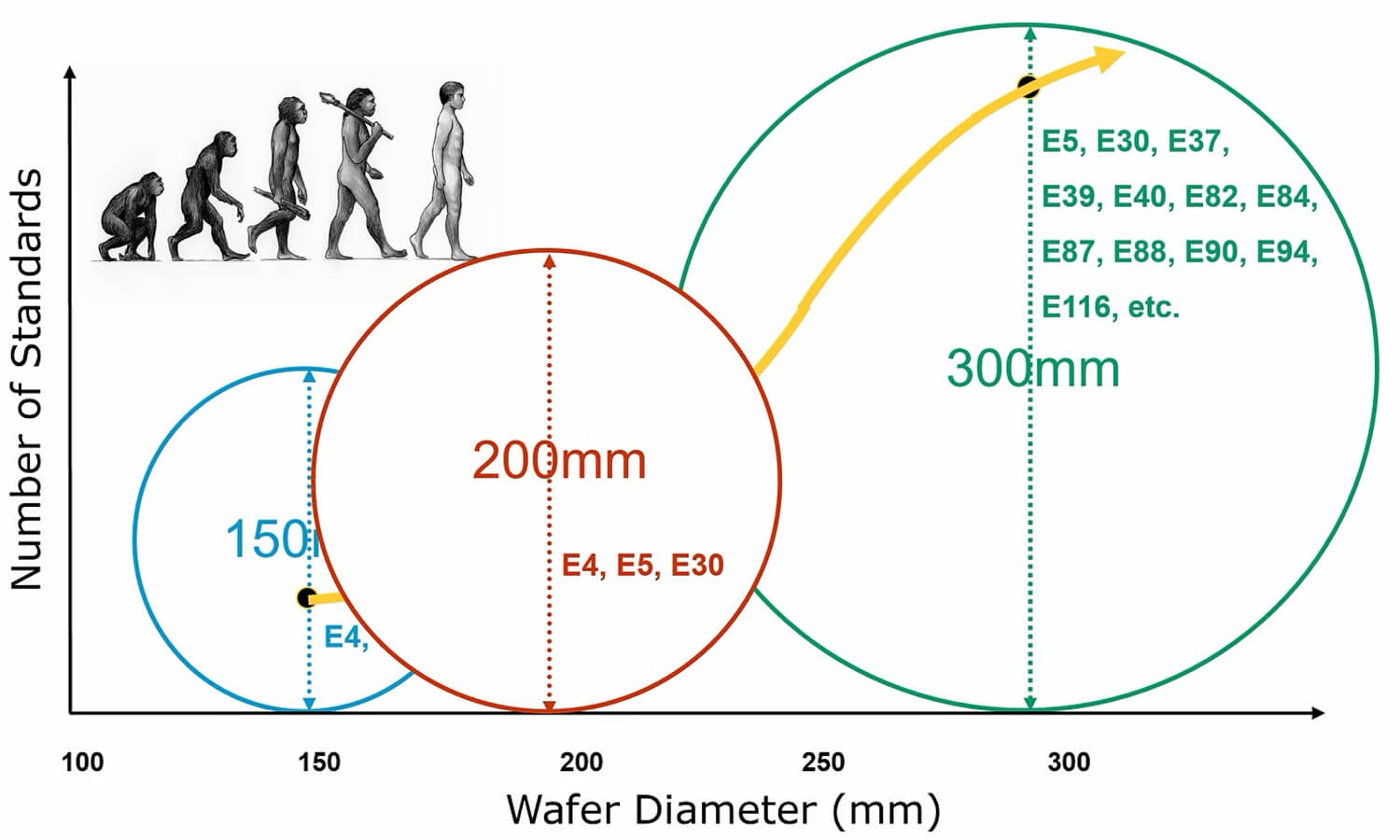
GEM300は、〜のスイートです セミ 300mm半導体ファブにおけるマテリアルハンドリングおよび設備制御の自動化を可能にする標準規格。SECS/GEM(SEMI E5 SECS-II および SEMI E30 GEM)を基盤とし、GEM300 はキャリア管理、基板追跡、制御ジョブ、プロセスジョブのサポートを追加します。.
このガイドでは、GEM300 とは何か、なぜそれが不可欠になったのか、そしてコア規格(SEMI E87、E90、E94、E40、E39)がどのように連携して、300mm生産の完全自動化を可能にするのかを説明します。.
For OEMs supplying tier-1 fabs and integrators onboarding tools into 300mm lines, GEM300 has become the compliance baseline. Leading customers such as Samsung, TSMC, and Intel expect GEM300 support out of the box, and equipment that ships with it onboards faster and holds its value longer. Explore our GEM300 solutions to see how a proven SDK can shorten development from months to weeks.
なぜ300mmファブにはGEM300が必要なのか
300mmウェーハは大型化・重量化し、チップのトポロジーは微細化するにつれて、手作業での材料搬送は非現実的で汚染のリスクも高くなりました。半導体工場では、OHT(Overhead Hoist Transport)およびAGV(Automated Guided Vehicle)システムを使用した材料搬送の完全自動化が必要となりました。.
このレベルの自動化をサポートするために、ファブは次のような標準化された通信を必要としました。
- キャリアデリバリーおよびバリデーション(SEMI E87)
- 基板処理中の追跡 (SEMI E90)
- ジョブ処理とジョブ管理の制御(SEMI E40、E94)
- オブジェクトライフサイクルサービス (SEMI E39)
These standards collectively form GEM300, the foundation of modern 300mm wafer fab automation.
Standardization is what makes fully automated 300mm production possible. Without a shared language for carriers, substrates, and jobs, every tool would need bespoke integration. GEM300 turns that fragility into a repeatable, vendor-neutral process that scales across the fab.
GEM300とは?
GEM300 is a suite of SEMI standards collectively known as the “SEMI 300mm Standards,” including SEMI E39, SEMI E40, SEMI E87, SEMI E90, and SEMI E94. GEM300 provides a sophisticated, standardized approach for factory hosts to control equipment and automate material handling.
GEM300 は、以下に示すようにSECS/GEM(SEMI E30 GEMおよびSEMI E5 SECS-II)の上に構築されています。
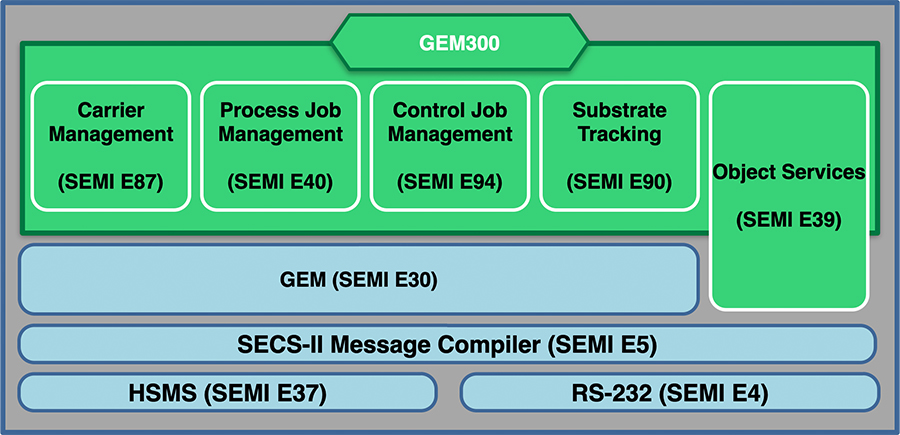
SECS/GEM handles the underlying communication (how equipment and host exchange messages) while GEM300 sits on top, adding the 300mm-specific object models for carriers, substrates, and jobs. In other words, SECS/GEM defines how tools talk. GEM300 defines what they talk about in a fully automated 300mm fab.
GEM300 vs Standard GEM
Standard GEM defines the baseline for equipment-to-host communication: alarms, status, events, remote commands, and data collection. GEM300 keeps every one of those capabilities and adds the object models a 300mm fab needs: carriers moving through OHT, substrates tracked wafer-by-wafer, and jobs orchestrated across chambers. In short, GEM300 is standard GEM plus the automation semantics that let a fully lights-out 300mm line actually run.
| Capability | Standard GEM | GEM300 |
|
Base protocol (SECS-II, HSMS) |
はい |
はい |
|
Alarms, events, status, remote commands |
はい |
はい |
|
Carrier management (E87) |
No |
はい |
|
Substrate tracking (E90) |
No |
はい |
|
Process job management (E40) |
No |
はい |
|
Control job management (E94) |
No |
はい |
|
Object services / lifecycle (E39) |
No |
はい |
For a 200mm fab or a standalone tool, standard GEM may be enough. For any 300mm production environment, GEM300 is the practical requirement, and building on the SECS/GEM foundation is what makes GEM300 implementation manageable.
GEM300規格
The five GEM300 standards work together as a system, each covering a distinct piece of 300mm automation. Read them as one integrated stack, not as independent specs.
| SEMI規格 | 説明 | 目的 |
|
E87 |
キャリアマネジメント(CMS)仕様 |
Manages the delivery, handling, and validation of the material. The objective is to validate that the expected material has been delivered to the equipment. |
|
E90 |
基板トラッキング管理仕様 |
Defines a standard means for tracking substrates in manufacturing in the same manner as E87 does for Carriers. |
|
E40 |
処理管理仕様(PJM) |
Process job management is concerned with the processing of material by a processing resource. Its function is to ensure that material delivered to the process module is processed with the correct recipe. |
|
E94 |
コントロール・ジョブ・マネジメント(CJM)の仕様 |
ホストが複雑な処理シナリオを管理できるように、材料処理装置上のプロセスジョブに監督レベルのコントロールを提供します。. |
|
E39 |
オブジェクトサービス標準:概念、動作、サービス |
Defines how various types of objects are dynamically created and deleted during material processing. Specifies object attribute interaction. |
Selective implementation is common in practice. Fabs and OEMs often prioritize E87 and E90 first (the material-tracking backbone) and layer E40, E94, and E39 as automation maturity grows. That phased path keeps the initial project manageable while still building toward full compliance.
GEM300 Compliance & SEMI Standards
SEMI maintains and evolves the GEM300 standards, and adherence to the current specification is what determines compliance. Tier-1 semiconductor manufacturers including Samsung, TSMC, Intel, and SK Hynix require GEM300 compliance for tool acceptance. Certification typically involves demonstrating that equipment implements the required object models and state machines for E87, E90, E40, E94, and E39, and passes host-side test cases across the full carrier-to-substrate-to-job lifecycle.
Standards matter because they are vendor-agnostic and forward-compatible. A tool built to GEM300 works with any compliant host today and stays valuable as automation infrastructure evolves. See how NxSphere GEM300 supports compliance with the SEMI object models and pre-built workflows that make certification a straighter line.
How to Implement GEM300
A well-scoped GEM300 project generally moves through four stages:
- Define scope: Identify which SEMI standards apply (E87 and E90 are usually mandatory; E40, E94, and E39 depend on level of automation). Document the state machines, data variables, alarms, and events your equipment must support.
- Develop or source drivers: Build in-house against the SEMI specs, or use a pre-built SDK like NxSphere GEM300, which ships with the object models, host simulator, and reference workflows.
- Test: Validate against a GEM300 host simulator, run through compliance test cases, and shake out edge conditions in carrier delivery, substrate tracking, and job orchestration.
- Deploy: Integrate with the customer’s MES and OHT/AGV systems, run acceptance tests on the fab floor, and iterate.
Realistic end-to-end timelines run 6 to 12 months when built from scratch, and can be cut significantly with a proven SDK. Phased approaches (start with E87/E90, layer the rest) reduce upfront cost and risk. Explore how our SDK accelerates GEM300 implementation.
GEM300 Use Cases Across Processes
GEM300 is not one workflow; it’s the connective tissue across the fab. A few of the most common places GEM300 shows its value:
- E-Test: Automated wafer flow from carrier delivery through electrical test, with full substrate traceability.
- Photolithography: Carrier and recipe management coordinated so the correct wafer meets the correct exposure step every time.
- Deposition: Parallel chamber processing orchestrated through control jobs, keeping throughput high without sacrificing traceability.
- Etch: Real-time feedback between the tool and MES enables tighter process control and faster response to drift.
GEM300-Compliant Drivers & Software
The build-versus-buy decision usually comes down to time and risk. Building GEM300 drivers from scratch typically runs 6 to 9 months of engineering effort, while a pre-built SDK can cut that to 2 to 4 months and reduce cost meaningfully. NxSphere GEM300 provides the SEMI object models, a host simulator, and ready-made workflows, so the engineering team is free to focus on the tool, not the standard.
Frequently Asked Questions About GEM300
Is GEM300 compliance required by all semiconductor OEMs?
GEM300 compliance is not universally mandated, but tier-1 OEMs such as Samsung, TSMC, Intel, and SK Hynix require GEM300 for tool acceptance. GEM300 compliance future-proofs equipment, commands a price premium on the secondary market, and opens doors to fab contracts. Smaller fabs may not enforce GEM300, but the industry trend is firmly toward standardization. Explore GEM300-compliant solutions.
Can legacy 300mm equipment be retrofitted to GEM300 compliance?
Yes. Legacy 300mm tools typically lack native GEM300 drivers but can be retrofitted via gateway middleware like NxSphere GEMBridge or SDK-based solutions such as NxSphere GEM300. Retrofit costs are a fraction of equipment replacement, with gateway deployments typically taking 2 to 4 weeks and SDK-based retrofits 6 to 12 weeks. Retrofit lets fabs leverage existing tool investments instead of buying new. See legacy equipment retrofit options.
How much does GEM300 implementation cost?
GEM300 implementation cost varies by scope. Single-tool retrofits sit at the lower end, multi-tool phased programs in the mid-range, and fab-wide rollouts at the top. ROI typically arrives within 1 to 2 years through faster setups, improved yield, and reduced downtime. Phased approaches reduce upfront cost and risk, and Insphere helps fabs prioritize high-impact equipment first. Schedule a cost and timeline consultation.
Ready to Implement GEM300?
Whether you are an OEM building a GEM300 tool from scratch or a fab retrofitting an existing fleet, the right SDK and partner turn compliance into competitive advantage. Insphere’s GEM300 solutions are built on 15+ years of production deployments across leading fabs and OEMs.